
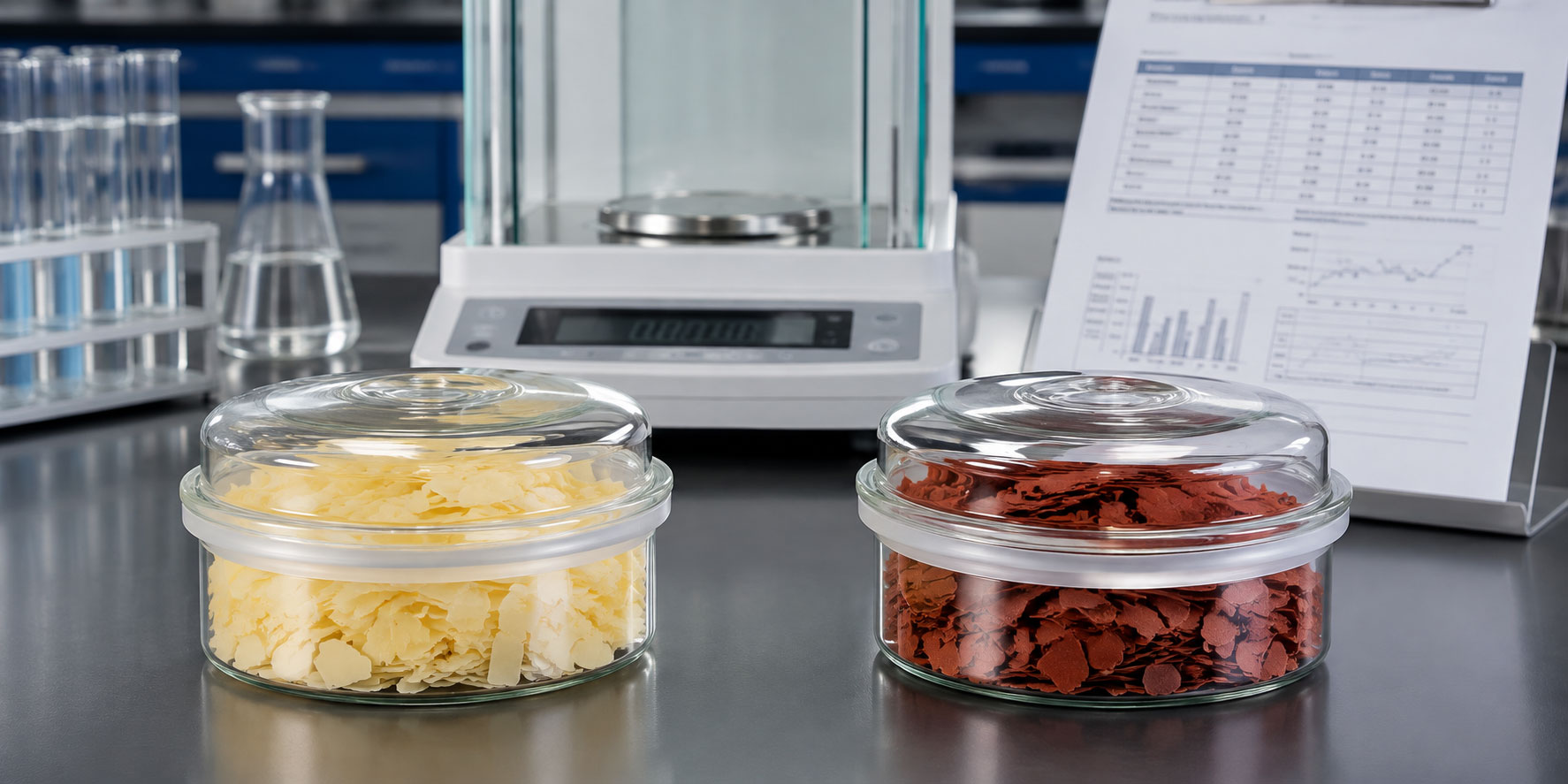
Sodium sulfide yellow flakes vs red flakes is not simply a visual comparison. Industrial buyers need to compare the measured Na₂S assay, iron level, impurity profile and process requirements. Yellow grades are commonly associated with lower iron and cleaner appearance, while red grades are often sold where a higher iron or broader impurity profile is acceptable. But color is only an appearance indicator; it cannot replace a batch Certificate of Analysis (COA).
At Kimya Kohan, we review appearance together with measured Fe and Na₂S assay. This guide explains how color relates to iron, where low-iron material can matter, and what buyers should verify before approving a batch.
Why do sodium sulfide flakes vary in color?
Commercial sodium sulfide is often supplied as hydrated flakes. In the market, flake color is a useful description, but not a universal grade standard. A light yellow or yellow product is often positioned as a low-iron grade, while red sodium sulfide flakes are commonly associated with a higher iron and impurity level.
One European product data sheet for Sodium Sulfide 60% Flakes specifies a light-yellow-to-yellow appearance, Na₂S content of at least 60 wt% and iron of no more than 10 ppm. That is one commercial specification, not an industry-wide threshold. Market claims about red-flake ppm values also vary and should not be treated as universal standards.
Color can identify the expected commercial form, but the COA must confirm the actual batch chemistry.
Iron content, purity and Na₂S assay are separate checks
Sodium sulfide iron content is one measurable impurity parameter, but it is not the same as total purity. A batch can meet its Na₂S assay while differing in iron or other secondary components. A cleaner-looking flake also does not prove a higher active Na₂S percentage.
Commercial specifications can separate appearance, Na₂S content, Fe ppm and additional impurity limits. Depending on the agreed grade, buyers may also review carbonate, sulfite or thiosulfate. Procurement and quality teams should therefore translate the word “purity” into measurable acceptance criteria.
Low iron sodium sulfide should be purchased against a defined maximum iron value and agreed assay, not against the word “yellow” alone. The same principle applies to a red grade: acceptance should follow the process specification and batch results.
Sodium Sulfide Yellow Flakes vs Red Flakes: Practical Buyer Comparison
| Buyer check | Yellow sodium sulfide flakes | Red sodium sulfide flakes | What to verify |
| Appearance | Typically light yellow to yellow in low-iron commercial grades | Red to darker market grades; exact appearance varies by supplier | Agreed appearance range, but do not use color as the release test |
| Iron | Low-iron options are commonly available | Often marketed with higher iron than yellow grades | Actual Fe ppm on the batch COA |
| Na₂S assay | Must be verified independently of color | Must be verified independently of color | Batch Na₂S assay and test basis |
| Impurities | Often selected when a tighter impurity profile is required | May be acceptable where the process tolerates a broader impurity profile | Relevant impurity limits for the application |
| Typical buying logic | Useful where iron or finished appearance is sensitive | Useful where process performance is proven with the offered grade | Process validation plus agreed specification |
This comparison should not be read as “yellow is better and red is worse.” A grade is suitable when its measured properties match the process. A mining grade may be accepted on different priorities than a color-sensitive tannery grade or textile application. Start from the process requirement, then choose the grade name—not the other way around.
Where does low-iron sodium sulfide matter most?
Leather and tannery applications
Leather buyers often pay close attention to iron and appearance when consistency matters downstream. A tannery grade described as yellow should still have a defined Fe limit and Na₂S assay. A color description without a measurable iron specification gives the buyer little basis for comparing lots.
Textile and color-sensitive processing
Textile buyers may prefer a cleaner, low-iron profile when unnecessary metal contamination could complicate color consistency. The key point is not the label “yellow”; it is whether the specification controls the impurities that matter and whether each batch is released against those limits.
Mining and less color-sensitive industrial use
In mining and other less color-sensitive applications, a red grade may be acceptable if the process is validated for its assay and impurity profile. A mining grade should be evaluated on process-relevant chemistry and consistency, not appearance alone. Substitution between grades should be confirmed through the user’s own technical validation.
Why color alone is not a sodium sulfide specification
Color is fast to observe, so it is useful for incoming inspection, but it is not quantitative. It cannot show the exact Fe ppm, active Na₂S content or other impurities, and it cannot confirm that a delivered lot matches the purchase specification.
At Kimya Kohan, our quality-control logic is to use appearance as a screening check and pair it with measured data. The relevant question is not only “Is it yellow or red?” but “Does the appearance match the agreed grade, and do the iron and assay results match the required limits?” This avoids a common sourcing mistake: comparing offers by color and price while the underlying specifications are not equivalent.
5 COA checks before approving yellow or red flakes
A buyer comparing sodium sulfide yellow flakes vs red flakes should request batch-specific documentation and check at least these five items:
- Na₂S assay: Confirm the active sodium sulfide content and the test basis stated for the batch.
- Iron result: Check the measured Fe ppm against the maximum agreed for your process.
- Relevant impurities: Review the impurity parameters defined in the purchase specification rather than assuming that color represents overall purity.
- Appearance: Confirm that the observed flake appearance is consistent with the agreed commercial grade, while keeping it separate from chemical acceptance criteria.
- Batch identity: Make sure the COA, product label, lot or batch number and order documents refer to the same material.
A TDS describes the supplier’s standard product specification. The COA should show results or conformance for the specific batch being supplied. They serve different procurement purposes and should not be treated as interchangeable.

How to choose between yellow and red flakes
Start with the process, not the color. If your application is sensitive to iron or appearance, define the maximum iron level, required Na₂S assay and any impurity limits before requesting offers. A low-iron yellow grade is then a logical candidate, provided its batch documentation confirms those limits.
If the process is less sensitive to iron and has already been validated with a broader grade, red flakes may be acceptable. In either case, compare like with like: assay, Fe, impurity limits, packaging and batch documentation should be aligned before price becomes the deciding factor.
For buyers who are new to the chemistry, our broader guide on what is sodium sulfide provides the context on commercial forms, properties and industrial use. When the requirement is already defined, Kimya Kohan can support review of current specifications for Na₂S flakes for industrial use and coordinate the documentation needed for procurement.
Frequently asked questions
Why are sodium sulfide flakes yellow?
Yellow sodium sulfide flakes are commonly associated with a lower-iron, cleaner commercial grade. However, yellow appearance by itself does not prove a specific iron value or Na₂S assay; the batch COA should confirm both.
Does red sodium sulfide mean lower Na₂S content?
Not necessarily. Color does not provide a reliable measurement of active Na₂S content. Red color is commonly associated with a different iron or impurity profile, but the Na₂S assay must be checked independently on the specification and COA.
What iron parameter should buyers check?
Check the supplier’s stated iron limit and the batch result, normally expressed as Fe ppm. The acceptable maximum should come from your process requirement or approved purchase specification, not from a generic market rule.
Can color replace a COA?
No. Appearance is useful for visual quality control, but it cannot verify Na₂S assay, iron or other impurities. A batch COA is the appropriate document for confirming the agreed chemical parameters.

Choose the batch by specification, not by color alone
The most useful way to compare sodium sulfide yellow flakes vs red flakes is to treat color as the starting observation, not the final specification. Yellow grades are often chosen when low iron or a cleaner appearance matters; red grades can be suitable where the process accepts their measured profile. In both cases, the decision should be based on the agreed Na₂S assay, iron limit, relevant impurities and batch COA.
For a procurement review, Kimya Kohan can help align the requested grade with current technical documentation and batch-verification requirements before shipment.