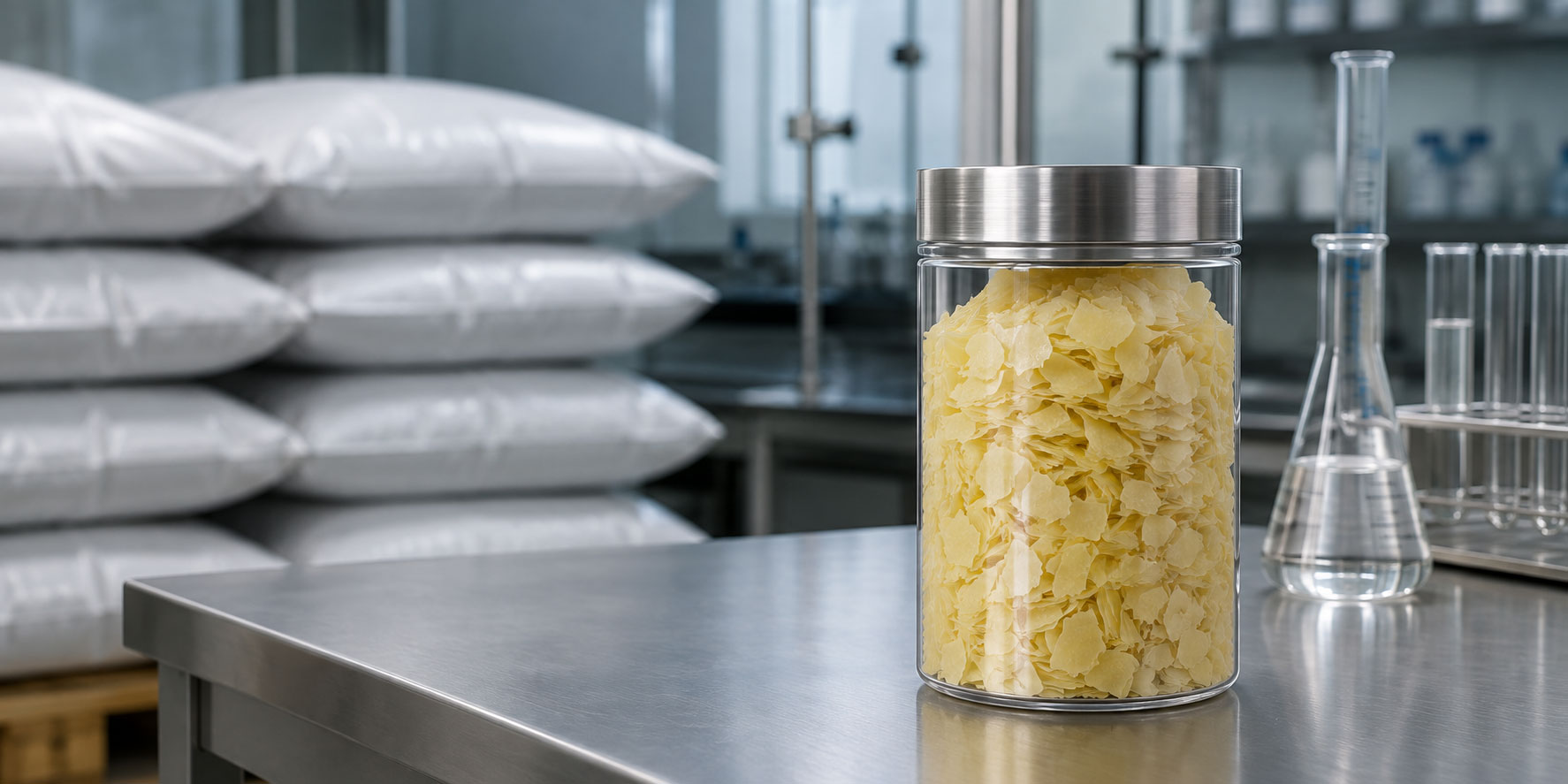
Sodium sulfide 60% flakes are a commercial hydrated form of Na₂S in which the sodium sulfide assay is specified at about 60% by weight, rather than a laboratory-grade anhydrous solid. For technical buyers, “60%” describes measured Na₂S content on the product specification or batch COA. It does not mean the remaining material is one single impurity or that every 60% flake product has one fixed hydrate formula.
This distinction matters when procurement and QA/QC teams compare offers. Buyers should check the assay basis, batch documentation, commercial form and relevant impurity limits instead of treating the product name as a complete specification. For broader chemical and application context, see our guide to what is sodium sulfide.
What Does 60% Mean in Sodium Sulfide 60% Flakes?
In industrial trade, sodium sulfide 60% flakes refers to a flake product whose Na₂S content meets the stated weight-percentage assay. A representative European product data sheet describes 60% flakes as a hydrate containing 40% crystal water and specifies Na₂S content of at least 60 wt%.
The practical interpretation is simple: the percentage is an assay value, not a statement that the flakes are 60% of a solution. The material is a solid flake grade. Depending on market and document conventions, buyers may also encounter Na2S 60%, sodium sulphide flakes 60%, hydrated sodium sulfide or 60 percent sodium sulfide for the same general commercial concentration class.
If a batch assays exactly 60.0 wt% Na₂S, 1,000 kg of product corresponds to 600 kg of Na₂S content on that assay basis. The other 400 kg should not automatically be called “pure water,” because the complete composition is defined by the actual grade and its specification, including water and permitted minor constituents.
Why Are Commercial 60% Flakes Hydrated?
Anhydrous sodium sulfide has the formula Na₂S and a molecular weight of about 78.04 g/mol. Commercial flakes are commonly supplied as hydrated sodium sulfide, so water is associated with the industrial solid form. In this context, industrial grade means the material is purchased against defined commercial specifications rather than reagent-grade purity. Documentation may therefore distinguish the anhydrous identity from the hydrate identity.
Hydrated flakes vs anhydrous Na₂S
For procurement, the difference is not simply “wet versus dry.” Anhydrous Na₂S is a chemical identity, while the commercial flake is an industrial material controlled by active Na₂S content and other specification limits. Buyers should compare the declared assay and required quality parameters rather than assume equal gross weight means equal active content.
Why a universal hydrate formula can mislead
It is tempting to convert a 60% grade into one formula such as Na₂S·xH₂O. That can be a rough chemistry model, but it should not replace batch documentation. Commercial hydrated material may be described by assay, water content and minor components, and the exact product condition may not behave like one pure stoichiometric hydrate. For purchasing and QC, the approved TDS and COA are the controlling documents.
How to Read the Na₂S Assay on a COA
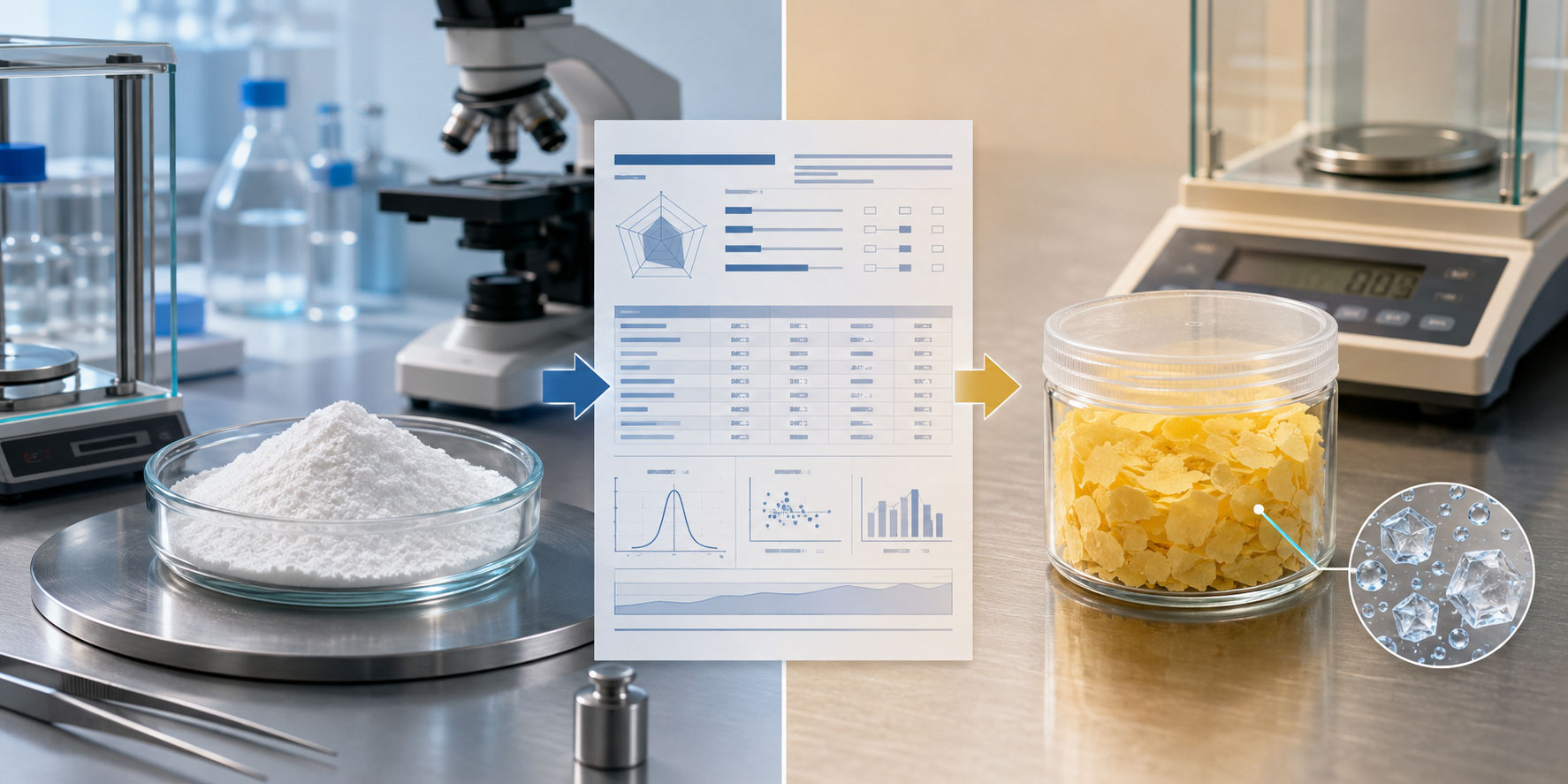
The COA turns a nominal product description into a batch-specific quality record. For sodium sulfide 60% flakes, start with the Na₂S content line and confirm the unit and acceptance limit. A “≥60 wt%” specification means the batch must meet or exceed that threshold under the stated analytical method.
Then confirm that the COA matches the material being purchased: product name or grade, batch or lot reference, and the parameters relevant to the process. Iron, carbonate, thiosulfate, sulfite or other limits may matter in some applications, but those requirements should be evaluated against the buyer’s technical specification rather than assumed from “60% flakes.”
| Document or claim | What it tells the buyer | What to verify |
| “60% flakes” | Nominal commercial concentration and form | Na₂S assay and grade definition |
| TDS | Typical or target product specification | Current revision and required parameters |
| COA | Results for a specific batch or lot | Batch identity, Na₂S result and relevant limits |
| SDS | Hazard, handling and safety information | Current document and product identity |
| Hydrate description | Commercial material contains associated water | Do not infer one universal hydrate formula |
Why Moisture and Commercial Form Matter to Buyers
Moisture is part of understanding delivered product form and active content. Two offers that look similar by name can differ in assay tolerance, impurity limits, packaging condition or document control. Comparing only price per gross tonne can therefore hide technical differences.
A common mistake is to use appearance as a shortcut for chemistry. Flake color can be a visual quality cue, but it should not replace measured assay or impurity data. If iron level or color grade matters to the process, state it as a measurable purchasing requirement.
5 Buyer Checks Before Approving Sodium Sulfide 60% Flakes
- Confirm the Na₂S assay. Make sure the specification states the required minimum or range and the COA reports the batch result on the same basis.
- Confirm the commercial form. Verify that the offer is for flakes and whether the documentation identifies the material as hydrated. Do not assume “60%” means a liquid solution.
- Match the COA to the batch. Check the lot or batch reference and the parameters required by QA/QC. A generic TDS is not a substitute for batch-specific results when a COA is required.
- Define application-critical limits. If iron or another impurity matters, include the requirement in the inquiry or purchase specification instead of relying on color or marketing terms.
- Check documents and packaging before order confirmation. Ask for the current TDS, COA availability, SDS, packaging format and destination-specific documentation needed for approval or import planning.
At Kimya Kohan, industrial inquiries can be reviewed against the buyer’s required assay, application-sensitive limits, quantity, destination and documentation needs. This keeps the commercial discussion tied to the actual purchasing requirement rather than a generic product label.
Safety and Document Control
Hydrated sodium sulfide is a hazardous industrial chemical. Authoritative product data identify corrosive hazards, and contact with acids can release toxic hydrogen sulfide gas. Storage, transport and handling decisions should follow the current SDS, applicable regulations and qualified site procedures.
The buyer-side rule is simple: use the correct SDS for the supplied grade, keep product identity consistent across the TDS, COA and shipping documents, and resolve any mismatch before acceptance. Detailed handling or emergency-response procedures belong in approved EHS documentation, not in a procurement article.
What to Verify Before You Buy
The phrase sodium sulfide 60% flakes is useful shorthand, but it is not a complete purchasing specification. The 60% figure primarily identifies the Na₂S assay class; the hydrated form, batch result, impurity limits, packaging and documentation complete the picture.
A sound purchase starts with the current specification and ends with batch-level verification. Before approving an order, confirm what “60%” means in the supplier’s documents and what evidence your QA/QC team requires. To review Kimya Kohan’s current Sodium Sulfide 60% Flakes information or request TDS/COA availability, use the product page and send your technical requirements with the RFQ.

Frequently Asked Questions
Is 60% sodium sulfide pure Na₂S?
No. The 60% figure is generally an Na₂S assay by weight for a commercial hydrated flake product. It is not anhydrous reagent purity and does not prove that the other 40% is only water.
Is sodium sulfide 60% flakes hydrated?
Commercial 60% flakes are commonly supplied as a hydrate. A representative European manufacturer describes its grade as a hydrate with 40% crystal water. Confirm the exact supplied grade from the current TDS and COA.
How is the Na₂S assay verified?
The supplier or manufacturer uses an analytical method defined for the product specification, and the batch result is reported on the COA. Buyers should verify the result, unit, specification limit and batch identity rather than infer assay from appearance.
What document confirms the batch assay?
The Certificate of Analysis, or COA, is the batch-specific document used to report the tested Na₂S assay and other listed quality parameters. The TDS describes the product specification, while the SDS addresses hazards and safe handling.